
Why Realtors Lose Leads (And How to Stop It)

Every Realtor has experienced it.
A lead comes in. There is interest. The conversation starts. Maybe the prospect requests information, asks about a property, or schedules an initial discussion.
Then suddenly, nothing.
The lead goes silent.
No appointment.
No contract.
No commission.
Most Realtors assume the problem is a lack of leads.
They invest more money into advertising, purchase additional lead lists, launch new marketing campaigns, and continuously search for more opportunities.
But in many cases, the real problem is not lead generation.
The real problem is lead conversion.
More specifically, the operational systems that manage leads after they enter the business.
The truth is that many Realtors already have enough opportunities entering their pipeline. What they lack is a consistent system for responding, nurturing, tracking, and converting those opportunities.
This distinction is critical.
A business with weak lead generation can survive by improving marketing.
A business with poor operational systems will continue losing opportunities regardless of how many leads it generates.
Understanding why Realtors lose leads is the first step toward fixing the problem.
The Real Cost of Lost Leads
When most people think about lost leads, they think about lost commissions.
While that is certainly true, the actual cost is much higher.
Every lost lead represents:
Lost revenue
Lost future referrals
Lost repeat business
Lost marketing investment
Lost pipeline momentum
Lost growth opportunities
Consider a Realtor spending thousands of dollars every month generating leads.
If operational inefficiencies cause even 20–30% of those leads to disappear, the financial impact compounds rapidly over time.
Many real estate professionals focus heavily on acquiring new opportunities while giving far less attention to protecting the opportunities they already have.
This creates a dangerous cycle.
More marketing creates more leads.
More leads create more operational pressure.
More pressure creates more missed opportunities.
The result is frustration, inconsistent revenue, and stagnant growth.
Protecting existing opportunities is often more profitable than generating additional ones.
Reason #1: Slow Response Times

One of the biggest reasons Realtors lose leads is delayed response.
Modern consumers expect speed.
When someone submits a form, requests information, or asks a question, they are often actively researching multiple options simultaneously.
The Realtor who responds first frequently gains a significant advantage.
Unfortunately, many leads wait:
Hours
Days
Or sometimes longer
before receiving meaningful communication.
During that delay, several things happen.
The prospect continues searching.
Competitors respond.
Interest decreases.
Urgency fades.
Trust weakens.
The opportunity becomes significantly harder to convert.
The reality is simple:
Speed matters.
A fast response communicates professionalism, reliability, and attentiveness.
A slow response communicates the opposite.
Even highly qualified leads can disappear when response times become inconsistent.
For many Realtors, improving speed-to-lead alone can create noticeable improvements in conversion performance.
Reason #2: Inconsistent Follow-Up
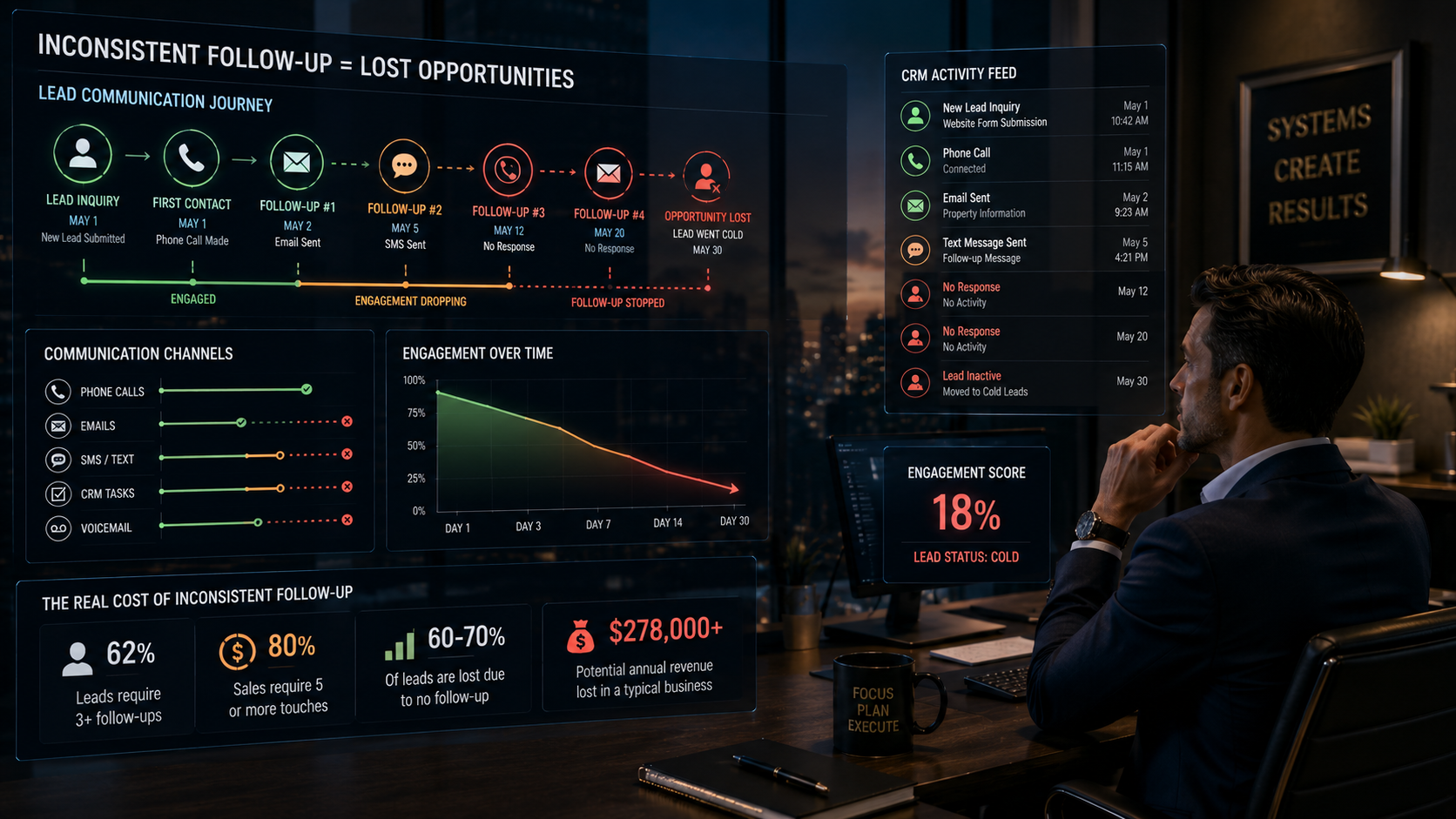
A surprising number of leads do not convert immediately.
Many prospects need time.
They may be:
Exploring options
Researching neighborhoods
Comparing agents
Waiting for financing
Preparing to sell an existing property
This means conversion often requires multiple touchpoints.
Unfortunately, many Realtors stop following up far too early.
The first call goes unanswered.
The first email receives no response.
The Realtor assumes the lead is no longer interested.
In reality, many prospects simply are not ready yet.
Without structured follow-up, opportunities disappear unnecessarily.
Successful Realtors understand that consistent communication builds trust over time.
Follow-up should not be random.
It should be systematic.
The businesses that maintain communication consistently often capture opportunities that competitors abandon.
Reason #3: Poor CRM Management

Customer relationship management systems are supposed to improve organization.
However, many Realtors use them inconsistently.
Common problems include:
Missing notes
Incomplete records
Outdated contact information
Untracked conversations
Forgotten follow-up tasks
When CRM data becomes unreliable, operational visibility suffers.
The Realtor no longer knows:
Which leads require attention
Which conversations are active
Which opportunities are stalled
Which prospects are most likely to convert
Without accurate information, decision-making becomes difficult.
Leads become easier to forget.
Communication becomes inconsistent.
Conversion rates decline.
A CRM should function as a central operational hub.
When it becomes disorganized, the entire lead management process suffers.
Reason #4: Pipeline Blind Spots

Many Realtors lose leads because they lack visibility into their pipeline.
They know leads are entering the business.
They know some opportunities are converting.
But they cannot clearly identify where prospects are dropping off.
This creates pipeline blind spots.
Examples include:
Leads that never receive follow-up
Prospects stuck in the same stage for weeks
Conversations that quietly disappear
Missed appointments
Incomplete qualification processes
Without visibility, problems remain hidden.
When Realtors cannot identify where opportunities are being lost, improvement becomes extremely difficult.
The highest-performing businesses monitor their pipeline carefully.
They understand where leads are entering.
They understand where they are progressing.
And they understand where they are being lost.
That visibility allows them to optimize their systems continuously.
Reason #5: Operational Overload

Real estate professionals wear many hats.
On any given day, they may be:
Managing listings
Scheduling showings
Answering calls
Sending emails
Negotiating contracts
Coordinating transactions
Meeting clients
Marketing properties
As business volume increases, operational complexity increases as well.
This is where many systems begin to fail.
The issue is rarely effort.
Most Realtors work extremely hard.
The issue is capacity.
There are only so many hours available each day.
Eventually, administrative demands begin competing with revenue-generating activities.
Important tasks get delayed.
Follow-up becomes inconsistent.
Communication becomes reactive instead of proactive.
The more overwhelmed the system becomes, the more opportunities are lost.
Operational overload is one of the most common growth barriers in real estate.
Reason #6: Disconnected Tools and Systems
Many real estate businesses rely on numerous software platforms.
These may include:
CRMs
Email marketing platforms
Scheduling software
Transaction management systems
SMS tools
Lead generation platforms
Each tool may work individually.
The problem occurs when they fail to work together.
Disconnected systems create:
Duplicate work
Communication gaps
Data inconsistencies
Missed follow-up
Workflow confusion
Adding more software does not automatically improve operations.
In many cases, it increases complexity.
The most successful organizations focus on system integration rather than software accumulation.
Connected systems create consistency.
Disconnected systems create friction.
This principle becomes increasingly important as businesses scale.
Why More Leads Won't Fix the Problem
One of the most common mistakes Realtors make is assuming that more leads will solve performance issues.
Often, the opposite occurs.
More leads entering a broken system create:
More missed opportunities
More administrative pressure
More communication delays
More pipeline confusion
Imagine pouring water into a bucket full of holes.
Adding more water does not solve the problem.
Fixing the holes does.
Lead generation remains important.
However, conversion infrastructure is equally important.
Before increasing lead volume, Realtors should evaluate whether their existing systems can consistently manage the opportunities they already receive.
Often, significant growth can occur simply by improving conversion processes.
Give one problem a defined next step. Discuss your lead follow-up workflow with AIMOZA. Bring an example and the systems your team uses.
How Top Realtors Protect Their Leads
Top-performing Realtors tend to approach lead management differently.
Rather than relying on memory or manual effort, they rely on systems.
These systems typically include:
Consistent response processes
CRM discipline
Pipeline visibility
Communication standards
Operational accountability
Their success is not based solely on marketing.
It is based on operational consistency.
Every lead receives attention.
Every opportunity is tracked.
Every conversation has visibility.
Every stage has structure.
The result is a more predictable conversion process.
Predictability creates growth.
The Role of AI in Lead Conversion
Modern AI systems are helping Realtors improve conversion performance in powerful ways.
AI can assist with:
Lead response
Communication workflows
Follow-up scheduling
CRM updates
Pipeline monitoring
Operational visibility
The goal is not to replace Realtors.
The goal is to support them.
Human relationships remain central to real estate success.
AI helps manage the operational complexity surrounding those relationships.
When implemented correctly, AI systems create:
Faster response times
More consistent follow-up
Better visibility
Improved operational efficiency
Reduced administrative burden
This is why operational AI is becoming increasingly important within modern real estate businesses.
Many of the highest-performing organizations are shifting from manual lead management toward connected operational systems.
Frequently Asked Questions
Why do Realtors lose leads?
Most Realtors lose leads because of delayed response times, inconsistent follow-up, poor CRM management, operational overload, and disconnected systems.
How quickly should Realtors respond to leads?
Ideally, Realtors should respond within minutes whenever possible. Faster response times generally improve engagement and conversion opportunities.
What is the biggest cause of lost real estate leads?
One of the biggest causes is inconsistent follow-up. Many prospects require multiple interactions before making a decision.
How important is follow-up in real estate?
Follow-up is extremely important because many buyers and sellers are not ready to act immediately. Consistent communication helps maintain trust and engagement.
Can AI help Realtors convert more leads?
Yes. AI can improve response times, automate follow-up, increase operational consistency, and improve pipeline visibility.
How does CRM management affect lead conversion?
Accurate CRM data improves visibility, organization, communication tracking, and follow-up consistency, all of which directly impact conversion performance.
What are pipeline blind spots?
Pipeline blind spots occur when Realtors cannot clearly identify where leads are getting stuck, delayed, or lost during the sales process.
How do Realtors stop losing leads?
Realtors can reduce lead loss by improving response times, implementing structured follow-up systems, maintaining CRM discipline, increasing pipeline visibility, and using connected operational systems.
Conclusion
Most Realtors do not have a lead generation problem.
They have a lead management problem.
Opportunities are often lost because operational systems fail to support consistent communication, follow-up, visibility, and workflow coordination.
The solution is not always more leads.
The solution is often better infrastructure.
By improving operational systems, Realtors can protect more opportunities, improve conversion performance, and create a more scalable business model.
The businesses that thrive over the next decade will not simply generate more leads.
They will build better systems to convert the leads they already have.
Build a Lead Conversion System That Works
If your business is generating opportunities but struggling with follow-up, visibility, communication, or operational consistency, it may be time to evaluate your infrastructure.
Explore how connected AI systems, workflow automation, and operational intelligence can help your business capture more opportunities and improve conversion performance.
Next Recommended Reading:
What Is AI Infrastructure for Real Estate? (Internal Link to Article #1)
Book your AIMOZA AI strategy call to discuss the workflow, integrations, and testing your next step requires. Scope and availability are confirmed separately.