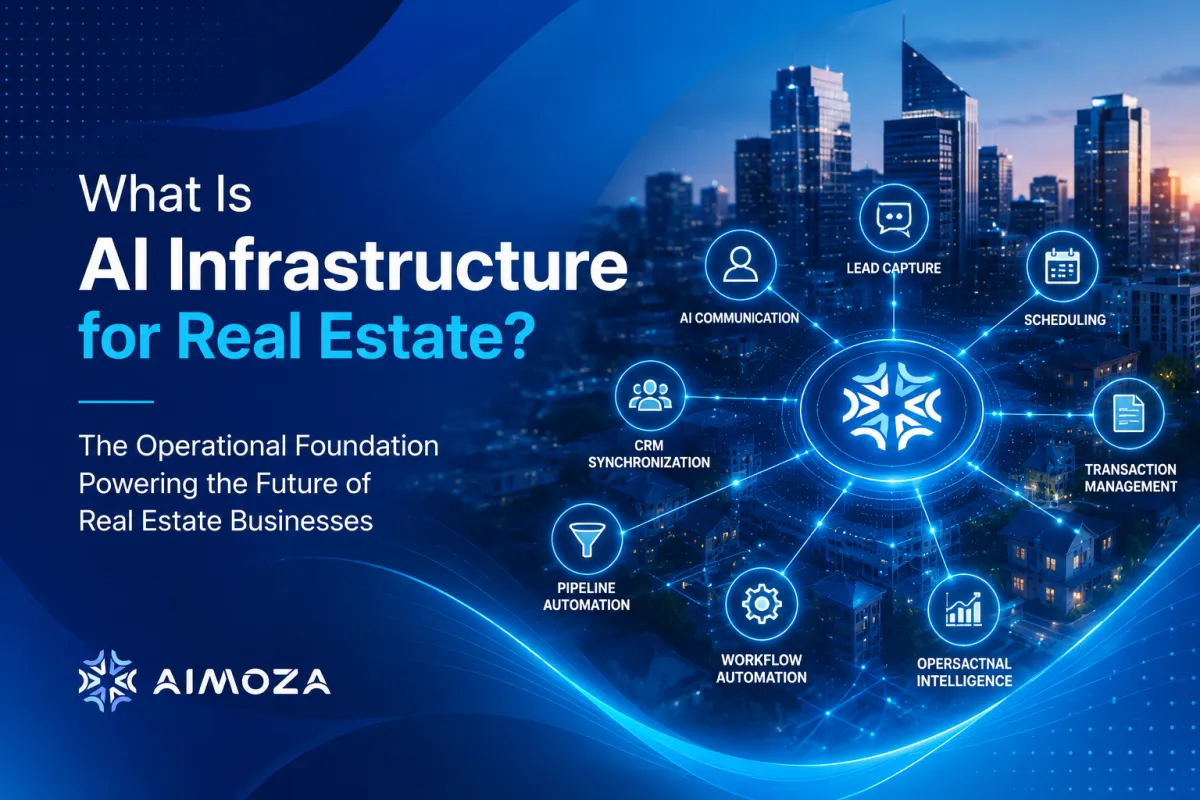
What Is AI Infrastructure for Real Estate?
AI infrastructure for real estate refers to connected operational systems that automate communication, lead follow-up, pipeline management, scheduling, customer workflows, and internal operational processes through synchronized AI-driven automation.
Modern real estate businesses are increasingly facing operational overload. Leads arrive from multiple platforms. Client conversations happen across text messages, emails, calls, CRMs, social media, and listing portals. Follow-up becomes fragmented. Pipeline visibility weakens. Tasks accumulate faster than teams can manage them manually.
Most Realtors do not lose opportunities because they lack leads.
They lose opportunities because their operational systems fail after the lead enters the pipeline.
AI infrastructure changes that equation.
Rather than functioning as isolated tools, AI systems operate as a connected operational layer that supports the entire client journey—from lead capture and communication to follow-up coordination and transaction workflows.
For modern Realtors, brokerages, and real estate teams, AI infrastructure is becoming less of a competitive advantage and more of an operational necessity.
Why Traditional Real Estate Operations Break at Scale
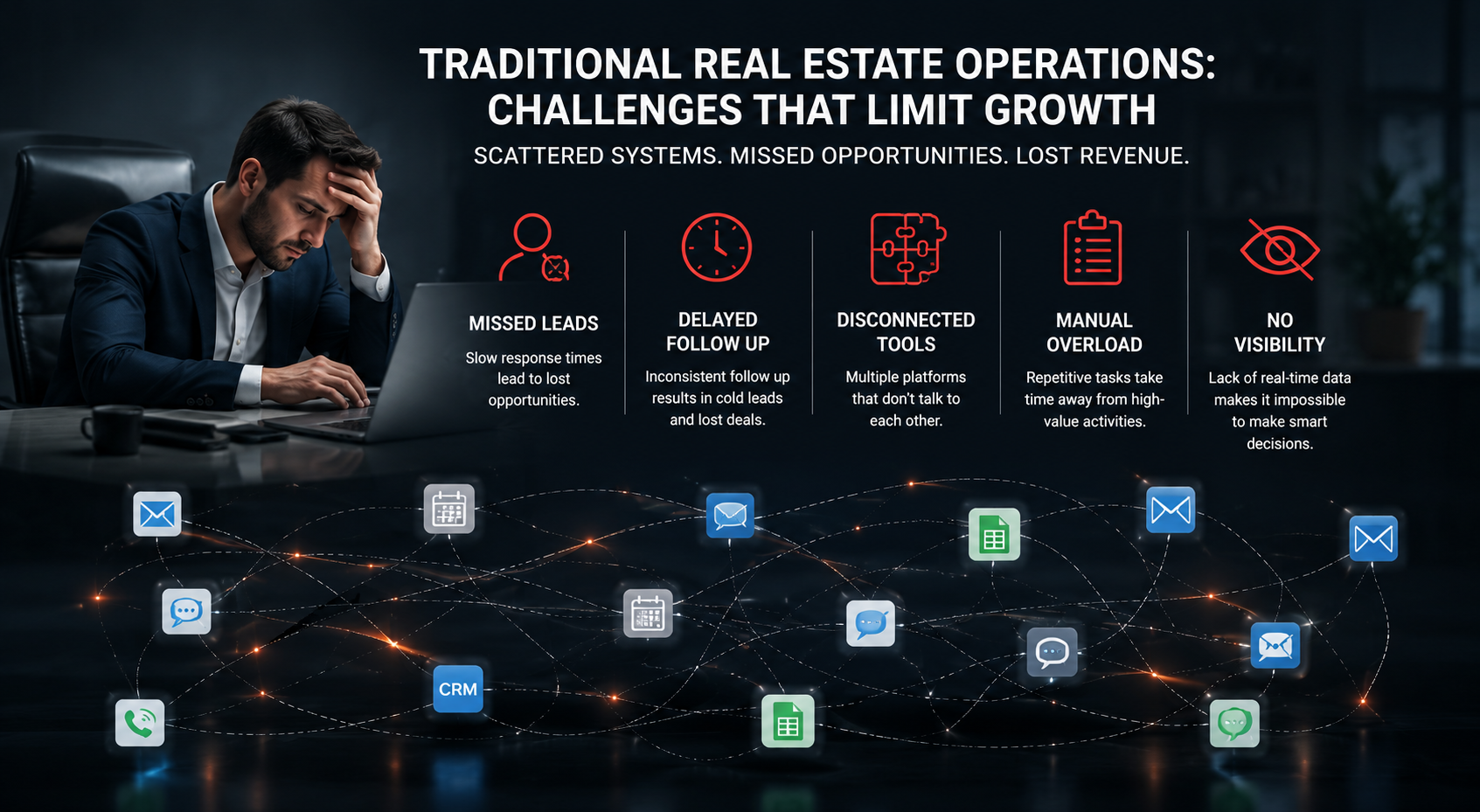
The real estate industry has historically operated on fragmented systems.
A Realtor may use:
one CRM for lead tracking,
another platform for email campaigns,
a separate scheduling tool,
text messaging manually,
spreadsheets for operational tracking,
multiple listing services,
social media DMs,
transaction management software,
and personal reminders to keep everything moving.
At low volume, this may appear manageable.
As business volume increases, operational fragmentation becomes increasingly dangerous.
Communication delays begin to compound.
Leads slip through the cracks.
Pipeline visibility decreases.
Client response times slow down.
Follow-up consistency weakens.
Administrative workload expands.
The Realtor eventually becomes trapped inside the operational complexity of their own business.
This is one of the largest hidden problems in modern real estate operations.
Many teams believe they have a lead-generation problem when in reality they have an operational systems problem.
Generating more leads into broken operational systems often increases chaos instead of revenue.
The issue is rarely a lack of opportunity.
The issue is the inability to consistently process, coordinate, track, nurture, and convert opportunity at scale.
This is where AI infrastructure becomes transformative.
Want to apply this to your real estate operation? Book an AIMOZA AI strategy call to discuss your lead sources, current tools, and next workflow priority.
What AI Infrastructure Actually Means
AI infrastructure is often misunderstood.
Many businesses incorrectly associate AI with:
chatbots,
isolated automations,
simple response tools,
or standalone software features.
True AI infrastructure is much broader.
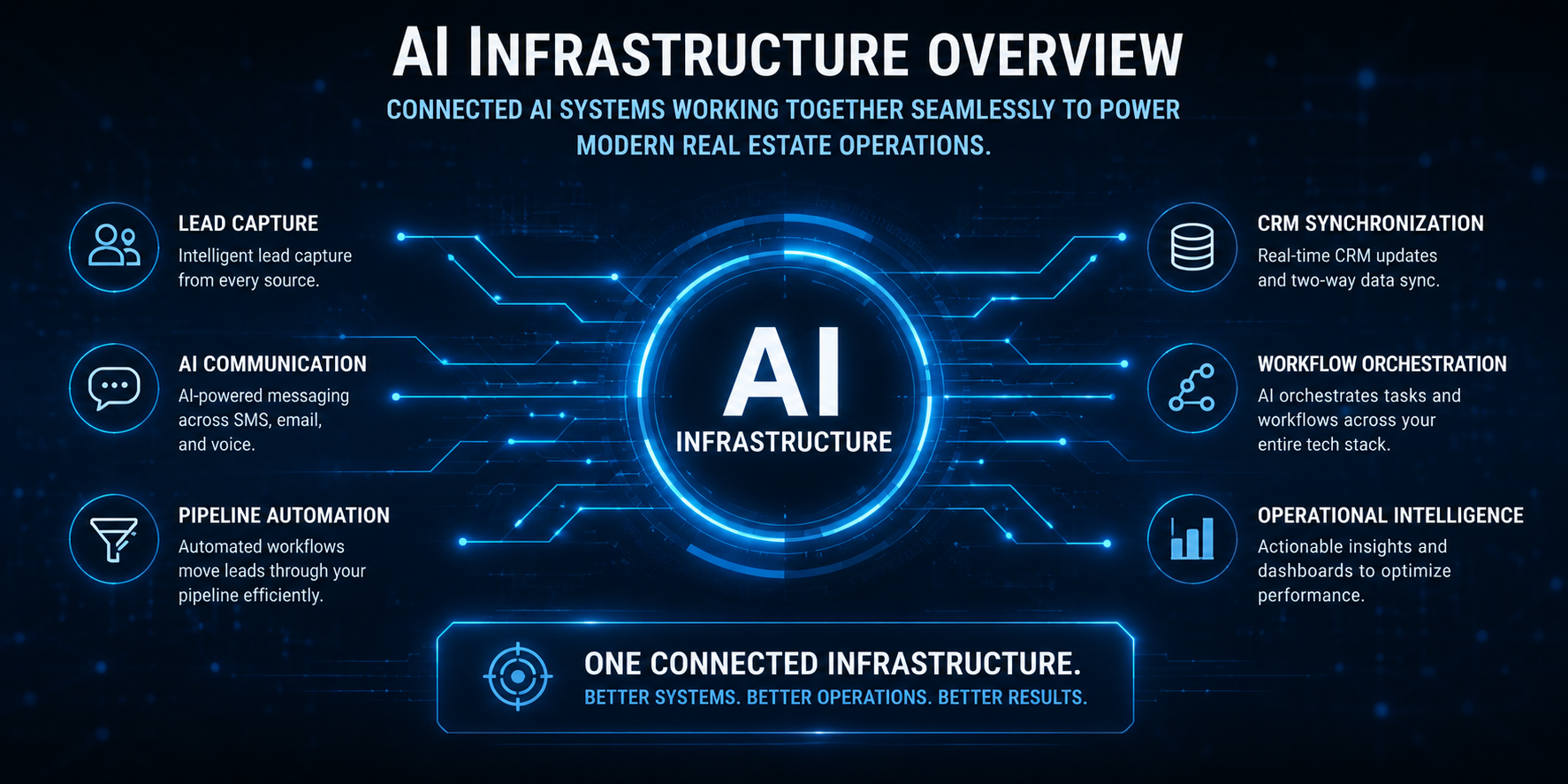
AI infrastructure functions as an operational coordination layer across the business.
It synchronizes workflows.
It orchestrates communication.
It automates repetitive operational processes.
It connects systems that traditionally operate independently.
It creates operational consistency across the entire client lifecycle.
In real estate, this means AI infrastructure can coordinate:
lead intake,
lead routing,
follow-up timing,
communication workflows,
appointment scheduling,
CRM updates,
transaction progression,
operational reporting,
and client lifecycle management.
Instead of Realtors manually managing dozens of disconnected operational tasks, AI infrastructure creates a connected workflow ecosystem.
This distinction is extremely important.
AI infrastructure is not merely automation.
It is operational architecture.
The goal is not simply to automate tasks.
The goal is to create synchronized operational systems that reduce friction, improve visibility, and increase scalability.
AI Systems vs Traditional Real Estate Automation
Traditional real estate automation usually focuses on isolated actions.
For example:
sending an automatic email,
triggering a reminder,
scheduling a follow-up,
or moving a lead between stages.
While useful, these systems often remain disconnected.
One automation rarely understands the broader operational context of the business.
This creates fragmentation.
Disconnected automation frequently leads to:
duplicated communication,
inconsistent follow-up,
poor visibility,
operational blind spots,
and manual oversight requirements.
AI infrastructure operates differently.
Instead of disconnected automation chains, AI infrastructure creates connected operational intelligence.
Traditional automation is typically:
reactive,
fragmented,
tool-based,
and dependent on constant manual supervision.
AI infrastructure is:
connected,
synchronized,
operationally aware,
scalable,
and system-driven.
For example, a traditional automation system may simply send an email after a lead form is submitted.
An AI infrastructure system can:
classify the lead,
route the lead,
initiate communication,
update the CRM,
trigger follow-up workflows,
notify the correct team member,
schedule appointments,
monitor responsiveness,
and maintain operational visibility across the entire process.
This is the difference between automation and infrastructure.
One performs isolated tasks.
The other coordinates operational systems.
Core Components of Real Estate AI Infrastructure
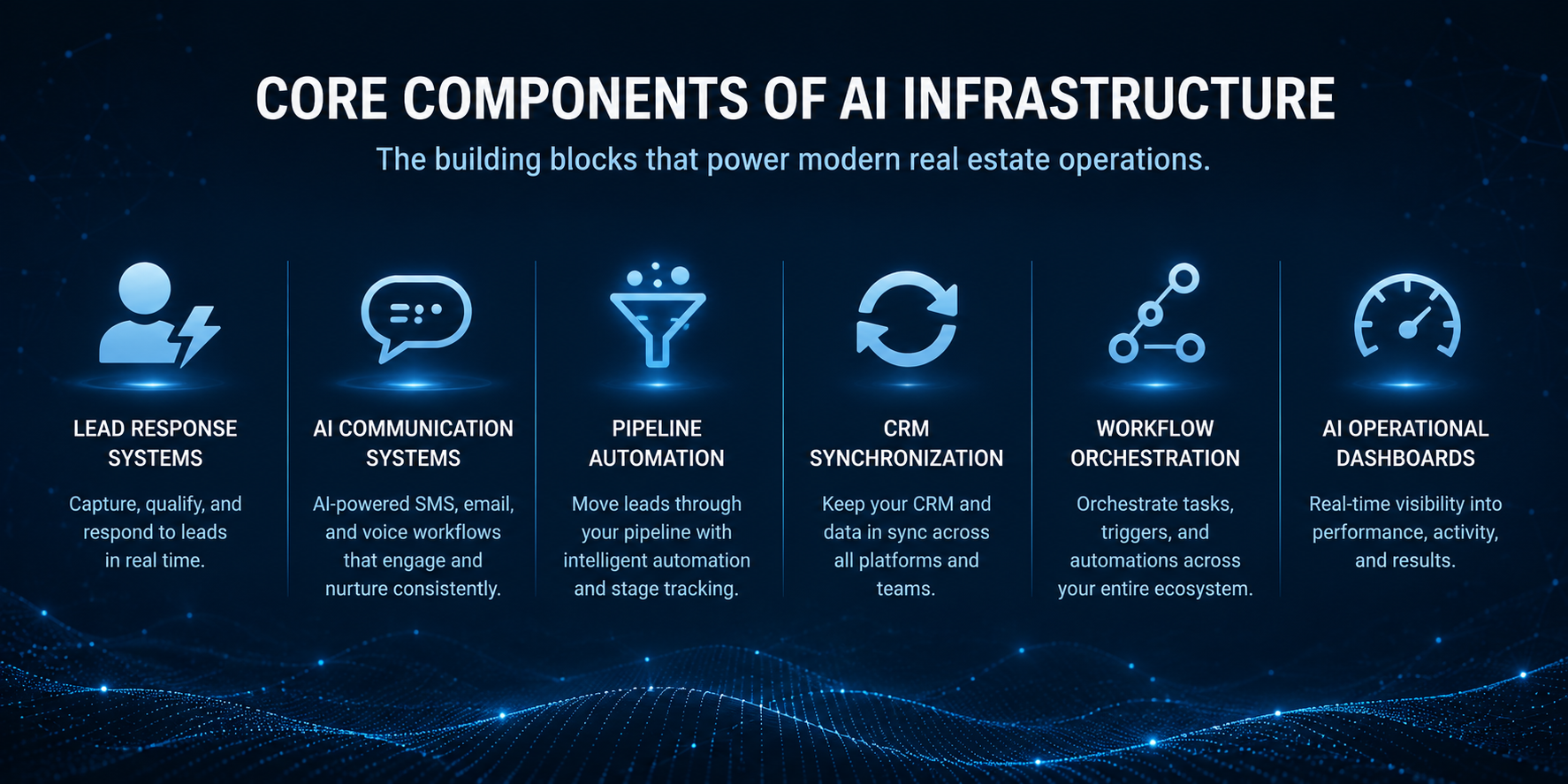
AI infrastructure is composed of multiple operational systems working together.
When integrated correctly, these systems create operational consistency across the business.
Lead Response Systems
Speed-to-lead is one of the most important variables in modern real estate conversion.
When lead response delays increase, conversion probability often decreases dramatically.
Many Realtors lose opportunities simply because:
responses are delayed,
follow-up is inconsistent,
or communication is forgotten during busy operational periods.
AI lead response systems help solve this problem.
These systems can:
initiate instant responses,
qualify inbound leads,
route leads to the appropriate agent,
schedule follow-up sequences,
and maintain communication consistency.
Instead of relying entirely on manual reaction speed, AI infrastructure creates operational responsiveness at scale.
AI Communication Systems
Communication fragmentation is one of the largest operational inefficiencies in real estate.
Conversations occur across:
SMS,
email,
calls,
CRM notes,
social media,
website forms,
and multiple third-party platforms.
AI communication systems synchronize these workflows.
This creates:
centralized visibility,
communication consistency,
operational coordination,
and improved client experience.
AI systems can also maintain follow-up continuity even during periods of operational overload.
This becomes increasingly valuable as teams scale.
Pipeline Automation
Real estate pipelines involve multiple stages:
inquiry,
qualification,
scheduling,
showings,
negotiations,
transactions,
and post-close follow-up.
Managing these workflows manually becomes increasingly difficult as volume increases.
Pipeline automation systems help coordinate:
stage progression,
reminders,
follow-up sequences,
task synchronization,
and operational tracking.
The result is greater pipeline visibility and reduced operational leakage.
CRM Synchronization
Many real estate businesses struggle with CRM inconsistency.
Information becomes outdated.
Notes become incomplete.
Follow-up history becomes fragmented.
AI infrastructure helps synchronize CRM systems with operational workflows.
This improves:
data consistency,
workflow visibility,
communication history,
and operational awareness.
Centralized operational visibility becomes increasingly important as businesses grow.
Workflow Orchestration
Workflow orchestration is one of the defining characteristics of AI infrastructure.
Instead of isolated automations operating independently, workflow orchestration coordinates operational systems together.
This includes:
sequencing tasks,
synchronizing workflows,
coordinating communication,
triggering operational actions,
and maintaining process continuity.
Operational orchestration reduces chaos.
It creates structure.
It improves scalability.
AI Operational Dashboards
Visibility is essential for operational growth.
AI operational dashboards help Realtors monitor:
lead responsiveness,
pipeline movement,
follow-up activity,
conversion performance,
operational bottlenecks,
and workflow consistency.
Without visibility, operational problems remain hidden.
AI infrastructure creates operational transparency.
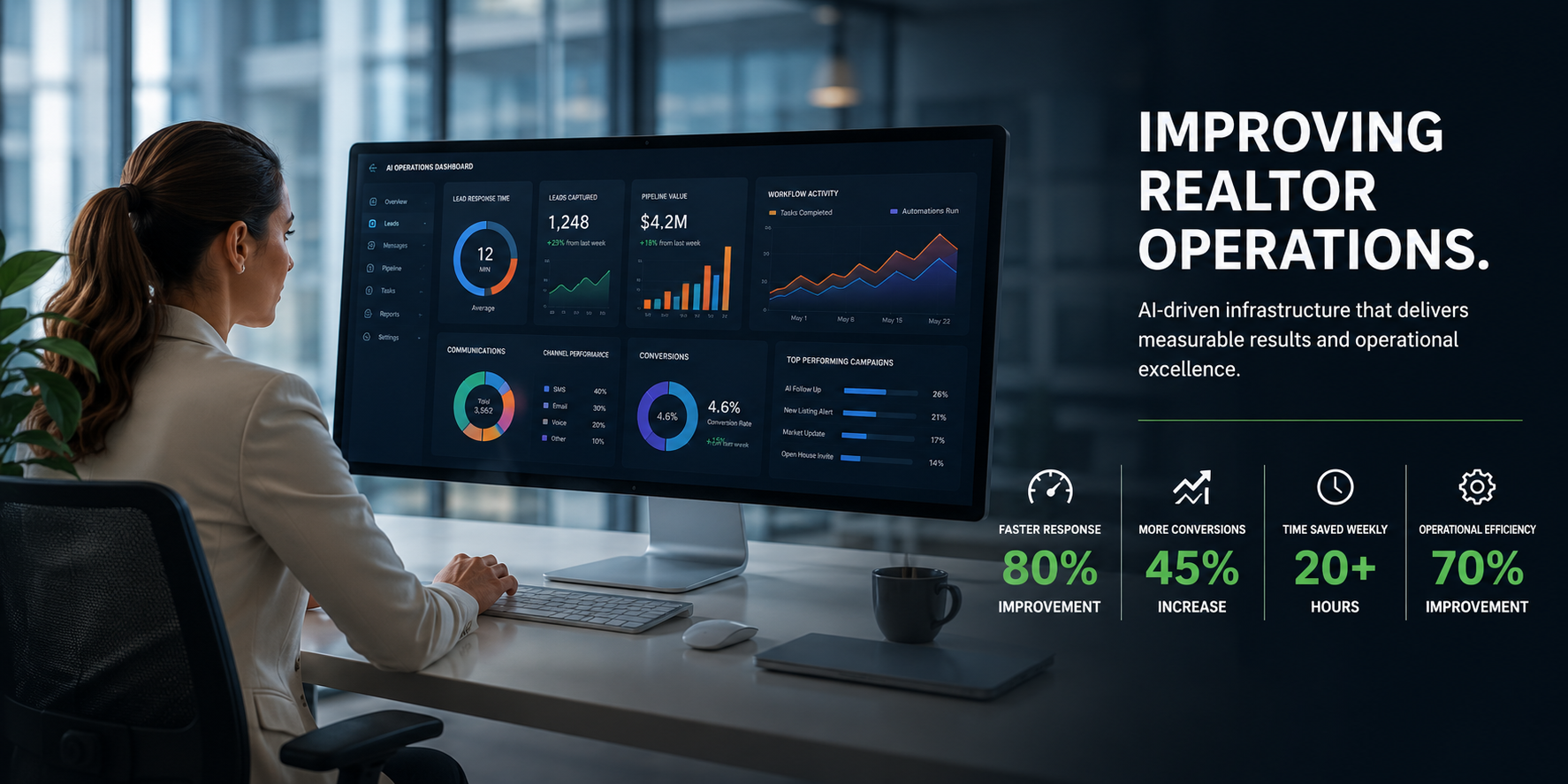
How AI Infrastructure Improves Realtor Operations
AI infrastructure improves real estate operations in multiple ways simultaneously.
Faster Response Times
Operational responsiveness improves significantly when communication workflows are automated.
Leads no longer sit unaddressed for extended periods.
Response consistency improves.
Operational delays decrease.
Reduced Manual Workload
Repetitive operational tasks consume enormous amounts of Realtor time.
Examples include:
follow-up reminders,
scheduling,
CRM updates,
communication coordination,
and pipeline tracking.
AI infrastructure automates many of these repetitive processes.
This allows Realtors to focus more heavily on:
relationship building,
negotiations,
client strategy,
and revenue-generating activity.
Improved Pipeline Visibility
Operational visibility becomes clearer when workflows are synchronized.
Teams can better understand:
where leads exist,
what follow-up has occurred,
what tasks remain incomplete,
and where operational bottlenecks exist.
Greater Scalability
Operational scalability becomes increasingly difficult without systems.
Many Realtors eventually hit a growth ceiling because operational complexity expands faster than manual management capacity.
AI infrastructure creates leverage.
It enables businesses to process greater operational volume without increasing chaos proportionally.
More Consistent Client Experience
Consistency matters heavily in client communication.
AI infrastructure helps maintain:
response consistency,
follow-up reliability,
communication timing,
and workflow coordination.
This improves overall client experience.
Operational Scalability and AI
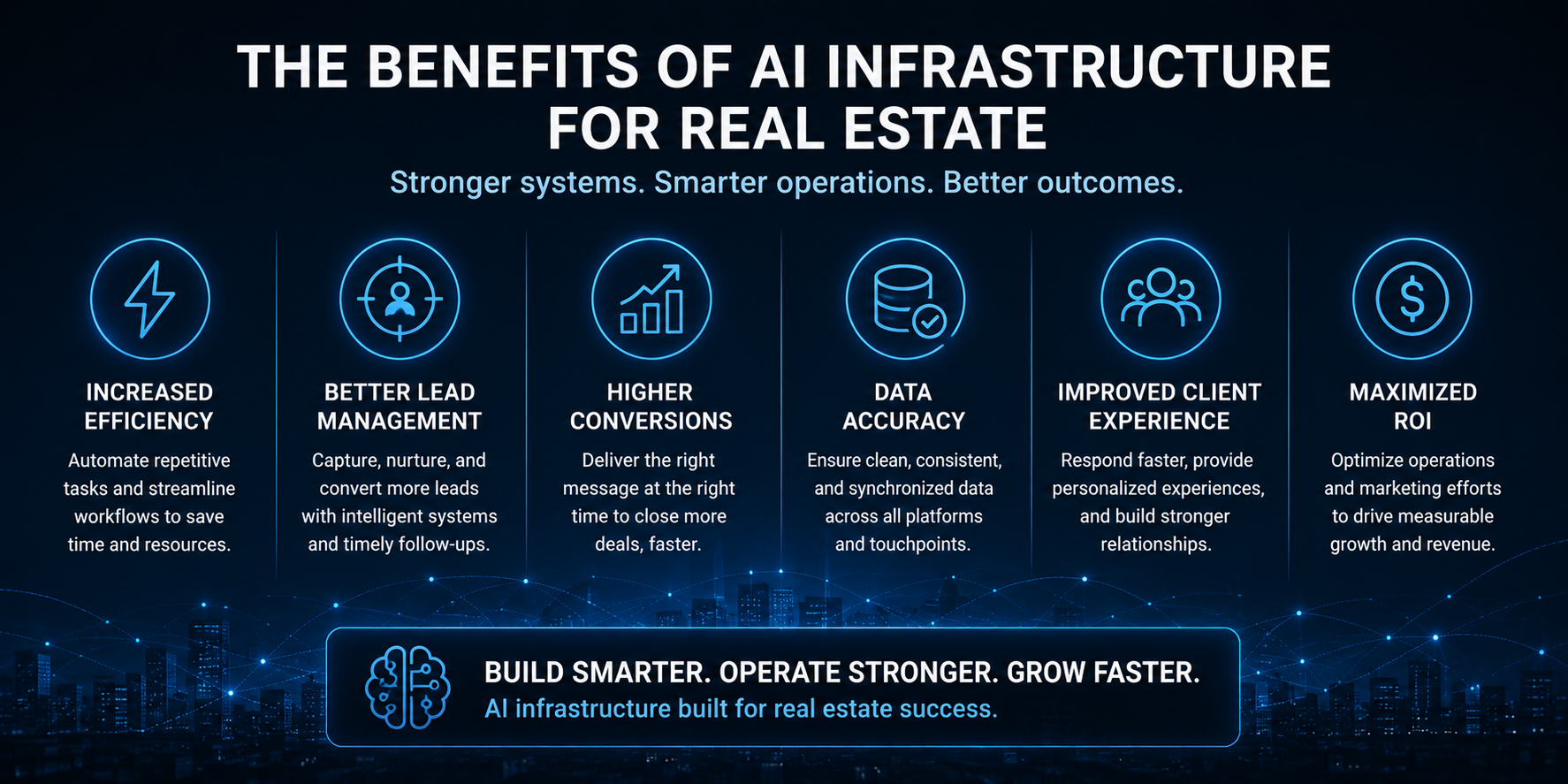
Scalability is one of the most important long-term operational challenges in real estate.
As lead volume increases, operational complexity expands.
Without infrastructure, growth often creates:
communication breakdowns,
delayed responses,
missed opportunities,
internal confusion,
and workflow overload.
This is one of the reasons many real estate businesses struggle to scale sustainably.
Operational systems do not evolve fast enough to support business growth.
AI infrastructure changes the scalability equation.
Instead of increasing operational labor linearly, Realtors can increase operational leverage.
AI workforce systems help automate:
repetitive communication,
scheduling coordination,
workflow progression,
pipeline monitoring,
operational reminders,
and data synchronization.
This reduces operational friction.
It creates scalability without requiring proportional increases in administrative workload.
Operational leverage becomes one of the primary strategic advantages of AI infrastructure.
The Future of AI in Real Estate
The real estate industry is moving toward increasingly AI-driven operational ecosystems.
This transformation extends far beyond chatbots.
Future real estate businesses will increasingly rely on:
AI communication systems,
operational AI workflows,
AI-powered lead routing,
automated coordination systems,
AI workforce infrastructure,
and operational orchestration platforms.
Brokerages will increasingly compete based on:
operational efficiency,
communication speed,
workflow consistency,
and scalability.
The businesses capable of creating connected operational systems will likely outperform businesses operating through fragmented manual coordination.
AI infrastructure will increasingly become:
operational infrastructure,
communication infrastructure,
workflow infrastructure,
and revenue infrastructure.
This does not eliminate human Realtors.
Instead, AI infrastructure amplifies operational capacity.
Human relationships remain essential.
However, AI systems increasingly manage the operational coordination surrounding those relationships.
This creates:
faster operations,
improved consistency,
reduced administrative overload,
and greater scalability.
The future Realtor will likely operate alongside AI systems rather than independently from them.
Why Connected Systems Matter More Than More Tools
One of the most common operational mistakes businesses make is continuously adding new tools without solving operational fragmentation.
More software does not automatically create better operations.
In many cases, it increases complexity.
Disconnected systems create:
duplicated tasks,
fragmented communication,
inconsistent workflows,
operational confusion,
and visibility problems.
This is one of the core reasons AI infrastructure matters.
The objective is not to collect more tools.
The objective is to create synchronized operational systems.
Connected systems improve:
coordination,
operational awareness,
workflow continuity,
communication consistency,
and scalability.
Modern operational success increasingly depends on system integration rather than software accumulation.
This is a core AIMOZA philosophy.
Disconnected systems create operational friction.
Connected infrastructure creates operational leverage.
Start with the workflow that needs attention. Discuss your implementation requirements with AIMOZA. Scope and integrations are confirmed after reviewing your process.
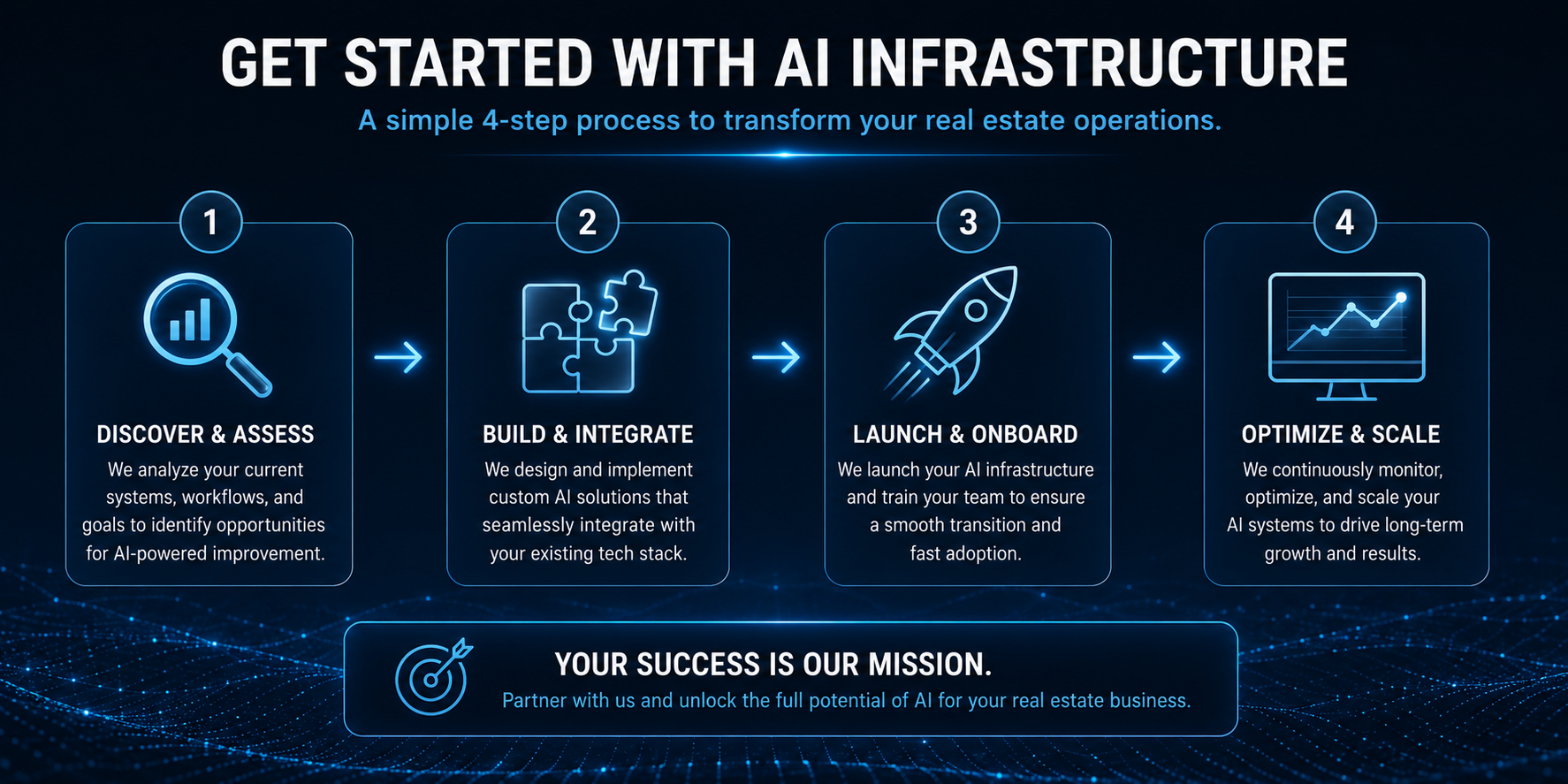
How Realtors Can Begin Implementing AI Infrastructure
Implementing AI infrastructure begins with operational awareness.
Before deploying automation, Realtors should first understand where operational inefficiencies currently exist.
Step 1: Map Existing Workflows
Identify:
how leads enter the business,
where communication occurs,
how follow-up is managed,
and where operational delays appear.
Step 2: Identify Bottlenecks
Look for:
delayed response times,
missed communication,
inconsistent follow-up,
fragmented CRM usage,
and repetitive manual processes.
Step 3: Evaluate Operational Systems
Review:
CRM structure,
communication systems,
scheduling workflows,
and pipeline visibility.
Step 4: Prioritize Workflow Coordination
AI infrastructure works best when systems communicate together.
Focus on:
synchronization,
operational visibility,
workflow continuity,
and centralized coordination.
Step 5: Deploy Incrementally
Operational AI systems should evolve strategically.
The goal is not to automate everything immediately.
The goal is to build connected operational infrastructure over time.
Frequently Asked Questions
What is AI infrastructure for real estate?
AI infrastructure for real estate refers to connected operational systems that automate communication, lead follow-up, workflows, scheduling, CRM coordination, and operational processes using AI-driven systems.
How does AI help Realtors?
AI helps Realtors improve response times, automate repetitive workflows, streamline communication, improve pipeline visibility, and reduce operational inefficiencies.
What is the difference between AI infrastructure and automation?
Traditional automation typically handles isolated tasks. AI infrastructure coordinates connected operational systems that work together across the business.
Can AI automate Realtor follow-up?
Yes. AI systems can automate follow-up workflows through SMS, email, scheduling coordination, reminders, and communication sequences.
What are AI agents for real estate?
AI agents are operational AI systems designed to handle specific workflows such as communication, lead qualification, scheduling, follow-up, and pipeline coordination.
Can AI integrate with CRMs?
Yes. AI infrastructure systems are commonly integrated with CRM platforms to synchronize operational workflows, communication history, and pipeline management.
How do Realtors begin using AI systems?
Realtors typically begin by mapping workflows, identifying operational bottlenecks, evaluating communication systems, and strategically deploying connected automation infrastructure.
What operational tasks can AI automate?
AI can automate:
lead follow-up,
appointment scheduling,
communication workflows,
CRM updates,
reminders,
pipeline tracking,
and operational coordination tasks.
Conclusion
The real estate industry is entering a new operational era.
As communication volume increases and workflows become more complex, disconnected systems create increasing operational friction.
AI infrastructure provides a new operational framework.
Rather than relying entirely on fragmented manual coordination, Realtors can build connected systems that automate communication, synchronize workflows, improve visibility, and create operational scalability.
The future of real estate operations will likely belong to businesses capable of combining human relationship-building with intelligent operational infrastructure.
AI infrastructure is not simply about automation.
It is about operational coordination.
It is about scalability.
It is about creating systems capable of supporting modern business growth.
For Realtors, brokerages, and real estate teams looking to improve operational efficiency, reduce missed opportunities, and scale more effectively, AI infrastructure is rapidly becoming one of the most important operational advantages in the industry.
Build Your Real Estate AI Infrastructure
Modern real estate businesses increasingly require connected operational systems capable of handling communication, lead management, workflow coordination, and scalability.
AIMOZA builds AI infrastructure systems designed to help Realtors streamline operations, automate workflows, improve lead conversion, and create scalable operational ecosystems for long-term growth.

Book your AIMOZA AI strategy call to discuss a practical next step for your business.