
The Hidden Cost of Delayed Follow-Up in Real Estate (And How AI Solves It)

A lead arrives while you are in a showing. You plan to respond afterward, but another appointment runs long. By evening, you are reconstructing the conversation from a notification and an incomplete CRM record.
The problem starts with an ordinary delay. It becomes an operational problem when nobody can tell which inquiries received a response, who owns the next step, or when follow-up should stop.
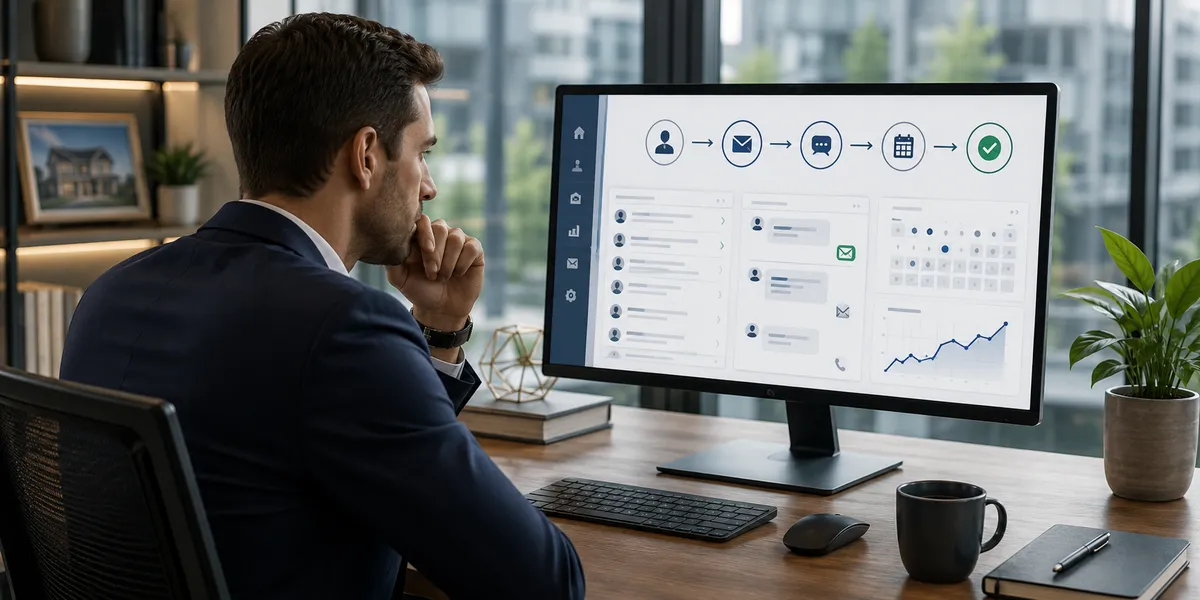
A consistent follow-up process gives every inquiry a recorded owner and next action. AI can support parts of that process when the channels, rules, and handoffs are configured and tested.
What delayed follow-up can cost a real estate team
A slow reply does not automatically lose a transaction, and a fast reply does not guarantee one. Buyers and sellers consider expertise, fit, availability, and many other factors. Response handling is one part of that experience that a team can measure and improve.
Unmanaged delays create several practical costs:
Missed conversations: a prospect may continue searching while waiting for an acknowledgment.
Repeated work: agents spend time finding messages, checking previous outreach, and re-entering information.
Unclear ownership: multiple people contact the same lead, or each assumes someone else has responded.
Incomplete follow-through: an initial reply happens, but the promised callback or appointment confirmation never does.
These are process gaps to investigate, not proof that every quiet lead represents lost commission. Start with your own records rather than an assumed industry-wide revenue figure.
Is follow-up slowing your team down? Book an AIMOZA AI strategy call to discuss your inquiry flow and the handoff that needs attention.
Acknowledgment and meaningful response are different
An acknowledgment confirms receipt. A meaningful response answers the inquiry or moves the conversation toward a useful next step. Measure both separately.
For example, a configured message might confirm that a listing inquiry arrived and ask which property the prospect means. A licensed team member may still need to verify availability, answer a transaction-specific question, or discuss representation.
Set expectations honestly. If a person will respond during business hours, say so. An automated message should not imply that a human has reviewed the inquiry when that has not happened.

Why follow-up breaks down
Disconnected inboxes, inconsistent CRM updates, and unclear assignments make a response process difficult to maintain. Adding more reminders does little if the team has no shared definition of a completed step.
Before adding automation, answer four questions: Where does each inquiry enter? Who owns it? What counts as a response? What happens if the normal path fails?
For the broader foundation, read What Is AI Infrastructure for Real Estate? For related lead-handling gaps, see Why Realtors Lose Leads (And How to Stop It).
Build a follow-up workflow with clear checkpoints
1. Capture the inquiry and its source
Record the contact details provided, the original question, the source, and the time received. Check for an existing record before creating another one. Keep the original inquiry available so an agent can understand the context.
Test every connected source separately. A working website form does not establish that a social ad form or missed-call workflow also works.
2. Assign an owner and a response target
Choose a responsible person or team and a response target that reflects actual staffing. Define coverage for evenings, weekends, absences, and reassignment. A notification alone is not an ownership rule.
3. Send an appropriate acknowledgment
Use approved language for the channel and situation. Confirm receipt, explain what happens next, and avoid promising an exact callback time unless the team can meet it. Apply the business's approved communication permissions, preferences, and suppression rules.
4. Collect useful context
An AI agent can collect basic details such as the property of interest, whether the inquiry concerns buying or selling, the preferred contact method, and the prospect's stated timing. Ask one clear question at a time.
Keep sensitive questions and decisions requiring professional judgment with the appropriate person. Route uncertainty instead of inventing listing details, financial advice, or transaction answers.
5. Confirm the next step
Offer an appointment only when the connected calendar has verified availability. Treat a booking as confirmed when the calendar record exists, the required contact details are recorded, and the confirmation step succeeds. An invitation to choose a time is not a completed booking.
6. Define follow-up and stop conditions
Specify the next action after no response, an appointment request, a request to stop, or a wrong number. Avoid unlimited sequences. Stop or reroute the workflow when the prospect opts out, an agent takes ownership, or another defined condition is met.
Related reading: AI Workflow Automation for Realtors.

Where AI fits—and where people remain accountable
AI can support intake, approved answers, basic routing, and scheduling through supported integrations. The team still owns message accuracy, professional conversations, exceptions, and relationship management.
A useful design makes failures visible. If a calendar connection fails, a message is not delivered, or a contact cannot be matched, create an actionable exception for a named owner. Do not mark the step complete simply because the workflow attempted it.

Test the workflow before sending traffic
Use internal test records and controlled channels before connecting live inquiries. Test a normal inquiry, a duplicate contact, an after-hours inquiry, an unavailable appointment slot, a delivery failure, an opt-out, and a human takeover.
For each scenario, inspect the actual contact record, message result, assigned owner, and next action. Keep a short record of expected versus observed behavior. A successful test message is only one part of end-to-end verification.
Measure improvement using your own baseline
Track time to acknowledgment, time to meaningful response, successful contact, confirmed appointments, missed handoffs, and staff time spent resolving exceptions. Define each measure consistently before comparing periods.
Separate outcomes by source and coverage hours where practical. More appointments after a workflow change may also reflect a different audience, offer, or advertising mix. Avoid assigning the entire change to automation without supporting evidence.
Choose one gap to fix first
Review a recent set of inquiries and identify the most frequent missed checkpoint. It might be ownership, first response, calendar confirmation, or follow-through after the first conversation. Document that step, set a clear owner, and test a bounded improvement before expanding.
AIMOZA's approach centers on connected inquiry handling, AI agents, qualification, booking, and follow-up. Any workflow should be demonstrated against its actual configuration before relying on it for live activity.
Define the delay before you try to fix it
“We respond quickly” can mean several different things. One agent may count an automatic acknowledgment. Another may count a completed call. An operations manager may look at the first appointment request. If these events share the same label, the team cannot identify where the process slows down.
Record a small set of checkpoints separately: inquiry received, acknowledgment delivered, meaningful response sent, contact established, next step agreed, and appointment confirmed when relevant. A prospect who receives a message but never speaks with the team has reached a different point from someone with a verified consultation on the calendar.
Set a working-hours target and a separate after-hours policy. The target should reflect staffing, channel behavior, and what the business has promised. Do not adopt an exact response-time benchmark simply because it appears in a vendor demonstration. Establish a measurable baseline, then decide what improvement your team can sustain.
Also define what happens when the target is missed. A useful exception identifies the contact, the unanswered question, the assigned person, and the next required action. An alert that only says “new lead” gives the team less context and can become another notification that everyone assumes somebody else will handle.
Separate operational cost from assumed lost revenue
It is tempting to multiply every unresponsive lead by a potential commission. That produces a large number, but it does not establish what the team actually lost. Some inquiries are duplicates. Some people are researching. Others may be outside the team's service area or already working with another professional.
Start with costs that can be observed. How much time does the team spend finding conversations? How often do two people repeat the same outreach? How many promised callbacks have no recorded owner? How many inquiries need a second intake conversation because the first record is incomplete?
Consider a hypothetical review in which staff find twenty records without a next action. Those are twenty records to investigate, not twenty lost transactions. Classify what happened: an unanswered inquiry, an appointment that was never confirmed, a duplicate, a stopped conversation, or a person who requested no further contact. Each category calls for a different correction.
For manual work, calculate time using the team's own observations. If a recurring reconciliation task takes a measured number of minutes, record its frequency and the staff time spent. Compare that effort after a process change, including time spent reviewing exceptions and maintaining the automation. Do not count the entire old task as savings if staff still perform part of it.
Revenue exposure belongs in a separate analysis. Review actual opportunities and outcomes, and acknowledge that pricing, market conditions, service fit, advertising, and agent execution influence results. A more reliable follow-up process is valuable even when you cannot isolate a precise revenue effect. Report what the evidence supports.
Three situations that need different follow-up paths
A buyer asks about a specific property
A listing inquiry needs enough context to identify the property and the question. A message such as “Is it still available?” may refer to a listing page, a social post, or an earlier conversation. Preserve the source and any property identifier rather than asking the prospect to repeat information the team already has.
When the property cannot be identified, ask a focused clarification. When the listing status cannot be checked against an approved current source, route the question to the person who can verify it. An immediate but incorrect answer can create more work than an honest acknowledgment with a clear next step.
The owner should receive the original question, the property reference, the preferred contact window, and any information already confirmed. If a prospect requests a showing, distinguish the request from an accepted appointment. The system should record the actual outcome instead of treating the conversation's intent as completed scheduling.
A seller is exploring a future move
A seller may have a longer decision window and a different question: what the process involves, when to prepare the property, or whether selling before buying is practical. Sending that person a generic buyer sequence misses the context even if the messages arrive on time.
Record the person's stated timing and the information requested. Do not infer urgency from a single word or assume the person wants frequent contact. The next step might be a conversation with an agent, a requested resource, or an agreed check-in at a later date. The workflow should reflect that agreement.
A long-term follow-up process needs ownership just as an immediate inquiry does. Someone must maintain the information, review replies, and decide whether the planned next step remains appropriate. A date on a sequence is a prompt to act; it is not proof that the relationship is progressing.
An open-house visitor requests information
Open-house inquiries may arrive in a batch, through handwritten notes, a form, or a conversation with an agent. Capture the context carefully. Attendance alone should not be treated as confirmation of a particular buying timeline, a requested appointment, or an unrestricted preference for future outreach.
After the event, reconcile the records before starting the next step. Confirm who spoke with the visitor, what was promised, whether the person already exists in the CRM, and who owns the response. A contact who asked for a property document needs that document or a clear explanation of how it will be delivered.
The operational goal is to preserve the commitment made at the event. The team should be able to answer: what did this person request, what did we agree to do, and did it happen? That is more useful than enrolling everyone in the same sequence and counting the messages sent.
Turn one of these scenarios into a practical next step. Discuss your real estate follow-up workflow with AIMOZA. Bring the tools you use and one example of a delayed inquiry.
Make the CRM record usable for the next person
A follow-up system depends on more than a name and phone number. The record should contain the original source, the question or stated intent, the assigned owner, the most recent meaningful interaction, the next action, and the next action's due point when relevant. Include communication preferences and any stop condition the workflow needs to respect.
Separate facts from interpretation. “Prospect said they expect to move in spring” is a statement with a source. “Hot seller” is a judgment that may mean different things to different agents. A qualification label becomes more useful when the business defines the criteria and keeps the underlying information visible.
Keep pipeline stages tied to evidence. An acknowledgment does not mean contact has been established. A scheduling link does not mean an appointment is booked. A proposed next step does not mean the prospect accepted it. When stages reflect verified events, the team can see which part of the process needs attention.
Plan for duplicate records and conflicting information. Decide which record is authoritative, who can correct it, and how connected workflows receive the correction. An accurate conversation summary loses value if a separate campaign still operates on an outdated phone number or an earlier contact preference.
Design outreach to stop, pause, and hand off correctly
Follow-up sequences are easier to start than to govern. Before creating more steps, define the conditions that end or pause them. Those conditions should include requests to stop, wrong contact details, a confirmed next step, a human takeover, and any other boundary established by the business.
Replies need attention. A prospect who responds with a specific question should not continue receiving messages that assume silence. If the system cannot interpret the response reliably, send it to the assigned person and pause the relevant sequence until the situation is resolved.
Give people a practical way to take ownership. Staff should know where to pause automation, see previous communications, and resume an appropriate process after reviewing the record. Document what “takeover” changes so an agent does not assume all automated channels have stopped when only one workflow has paused.
Communication permissions and preferences need review across connected systems. The operating procedure should identify the approved rules, the source of the preference, and the person who resolves conflicts. This article describes process design; the business should use its approved policies for the actual channels and audiences involved.
A maintained exception queue is part of the system. Review delivery failures, unresolved questions, missing owners, and records that have not progressed. Assign each exception to a person with a clear next action. Do not close it just because a retry was attempted; inspect the result of that retry.
Run a controlled pilot with a clear definition of success
Choose one source and one bounded workflow for the initial pilot. A single listing-inquiry form or a controlled missed-call test is easier to diagnose than every inbound channel at once. Document the expected contact record, acknowledgment, ownership, and next action before running the test.
Use internal contact details and realistic sample messages. Include missing information, an existing contact, an after-hours inquiry, a person who asks for a human, and a message that falls outside the approved knowledge base. Check whether the record and next action remain coherent after each case.
Then test failures deliberately within the controlled environment. What happens if the calendar has no suitable time? If a required field is missing? If a delivery attempt fails? If a tool reports an error? The expected result should include a visible exception and a responsible person, not a fabricated success message.
Define success before evaluating the pilot. A useful criterion might require every test inquiry to have one assigned owner and an accurate next action, while all intentional failures appear in the exception review. Use the criteria that match the workflow rather than a generic promise of better conversions.
Keep the test evidence brief but specific: scenario, expected behavior, observed record, observed action result, and disposition. Correct the failure and retest the affected path. Expand coverage only after the team can explain what the workflow did and what happens when it cannot continue.
Review the process without creating another reporting burden
A small review can reveal more than a dashboard full of unconnected numbers. Sample recent inquiries and look for missing owners, repeated questions, failed confirmations, and commitments with no next action. Include successful cases so the team can distinguish a normal path from an exception.
Review response timing by source and coverage hours where practical. A batch of weekend inquiries and a batch received during staffed hours may need different interpretation. Keep automatic acknowledgment separate from staff contact so a faster automated reply does not conceal a growing queue of unanswered questions.
Look at the quality of the handoff, not just its speed. Did the receiving person have the original question? Was the preferred contact window accurate? Did the prospect have to repeat the same details? Was uncertainty visible? These checks show whether the process reduces coordination work or merely moves it to another screen.
Use findings to make one specific correction at a time. Adjust an ownership rule, clarify an intake question, correct a knowledge-base entry, or improve an exception alert. Record the change and inspect the affected path again. This creates an operating improvement process that the team can maintain as volume changes.
Questions to answer before increasing advertising
Before sending more traffic, trace an inquiry from its source to a verified next step. Confirm which channels are connected, who covers each one, and where failures become visible. If the team cannot explain that path, more traffic can make the uncertainty harder to manage.
Check that the public promise matches the actual operating process. A page that promises an immediate conversation needs a different coverage model from one that promises a response during office hours. Update the workflow or the promise so the experience is consistent.
Finally, confirm that the team has capacity for the next step. A reliable acknowledgment cannot create calendar availability or replace the person responsible for an agent conversation. Marketing and operations need a shared view of the handoff so successful inquiry capture leads to an actionable commitment.
Give each communication channel a defined role
A phone call, a text reply, a website inquiry, and an email can all belong to the same conversation, but they do not behave the same way. Document what each channel is intended to do and where its record becomes visible. A team should not need to search several inboxes to discover that a prospect already answered.
For calls, distinguish an attempted call from an answered conversation. A voicemail is another outcome with its own approved next step. For written messages, distinguish a send attempt from a delivery result and a delivery result from a reply. These differences matter when deciding whether a sequence should continue.
Channel switching also needs context. If a person replies by email after receiving a text, an unrelated automated text should not immediately ask the same question again. Test whether connected workflows share the relevant state. Where they do not, use a narrower process and explicit human coordination instead of implying that the channels are synchronized.
Keep a simple coverage map: channel, monitored inbox, responsible person, coverage hours, expected action, and fallback. Review it when staff roles or integrations change. This gives the business a concrete operating reference and makes gaps easier to identify before they affect live inquiries.
Frequently missed details in a follow-up rollout
Time zones, record ownership, and calendar changes deserve explicit tests. A proposed appointment time should be understandable to both the prospect and the receiving agent. Reassignment should transfer the next action, not leave the old owner silently responsible. A canceled appointment should not keep triggering reminders that assume it is still happening.
Also check the knowledge used in routine answers. Office hours, service areas, scheduling instructions, and escalation contacts can change. Give each source an owner and a review trigger. An agent that answers accurately from an outdated document still creates an inaccurate customer experience.
Maintain a concise change record so the team knows which workflow and message versions were tested. If several changes happen at once, it becomes harder to tell which change caused a failure or an improvement. Keep the first rollout narrow enough that a responsible person can explain the complete path.
Frequently asked questions
How quickly should a real estate team respond to a lead?
Set a target based on the inquiry channel and actual team coverage. Track automated acknowledgment separately from a meaningful response, and communicate after-hours expectations clearly.
Can AI handle every real estate inquiry?
No. Use AI for defined intake and approved workflow steps. Route uncertain, sensitive, and transaction-specific questions to the appropriate professional.
Will faster follow-up guarantee more sales?
No. It can improve the response process, but sales also depend on lead quality, the offer, fit, market conditions, and the team's follow-through. Measure results using your own baseline.
Do we need to replace our existing CRM?
Not necessarily. Review integration support, data quality, ownership rules, and reporting needs before deciding whether the current system can support the intended workflow.
What should happen when someone asks us to stop contacting them?
Stop the relevant automated outreach, record the preference, and ensure connected workflows respect it. Include this scenario in testing before activating live follow-up.
How should a team estimate the cost of delayed follow-up?
Measure identifiable work and missed checkpoints first: reconciliation time, duplicate outreach, missing next actions, and failed confirmations. Treat potential transaction revenue separately, and avoid assuming that every unresponsive inquiry would have become a client.
What should happen to inquiries received after hours?
Use a documented coverage policy. An acknowledgment can explain when a person will respond, while ownership and a next action should still be recorded. Test how the workflow handles urgent questions, unavailable calendar slots, and requests for a person.
How should long-term nurture differ from immediate follow-up?
Immediate follow-up addresses the current question and next step. Longer-term communication should reflect the person's stated timing and preferences, with defined ownership, review points, and stop conditions. Reassess the sequence when the person replies or their situation changes.
A stronger next step for your real estate operation
The purpose of faster follow-up is to create a clearer, more reliable path from an inquiry to an appropriate conversation. Start with one measurable gap, assign ownership, and verify the next action. Expand only when the team can see both successful outcomes and exceptions.
Explore AI Infrastructure for Real Estate to see how inquiry handling, agents, calendars, and CRM records fit into the broader operating design.
Discuss your follow-up workflow with AIMOZA
Bring your lead sources, current response process, and the point where follow-up stalls. Use a 45-minute strategy call to discuss a defined next step and the integrations, ownership, and testing it requires. Scope and availability are confirmed separately.